

Patience Got Paid, The Panic Sellers Got the Receipts

If the first quarter of 2026 tested your patience, the second quarter wrote you a thank-you note.
Three months ago we were talking about oil spikes, a shooting war, and a market that fell 4.3%. Now we’re talking about one of the best quarters of the century. Same market. Same investors. Ninety days apart.
Here’s what actually happened, and what it means for you.
The numbers first
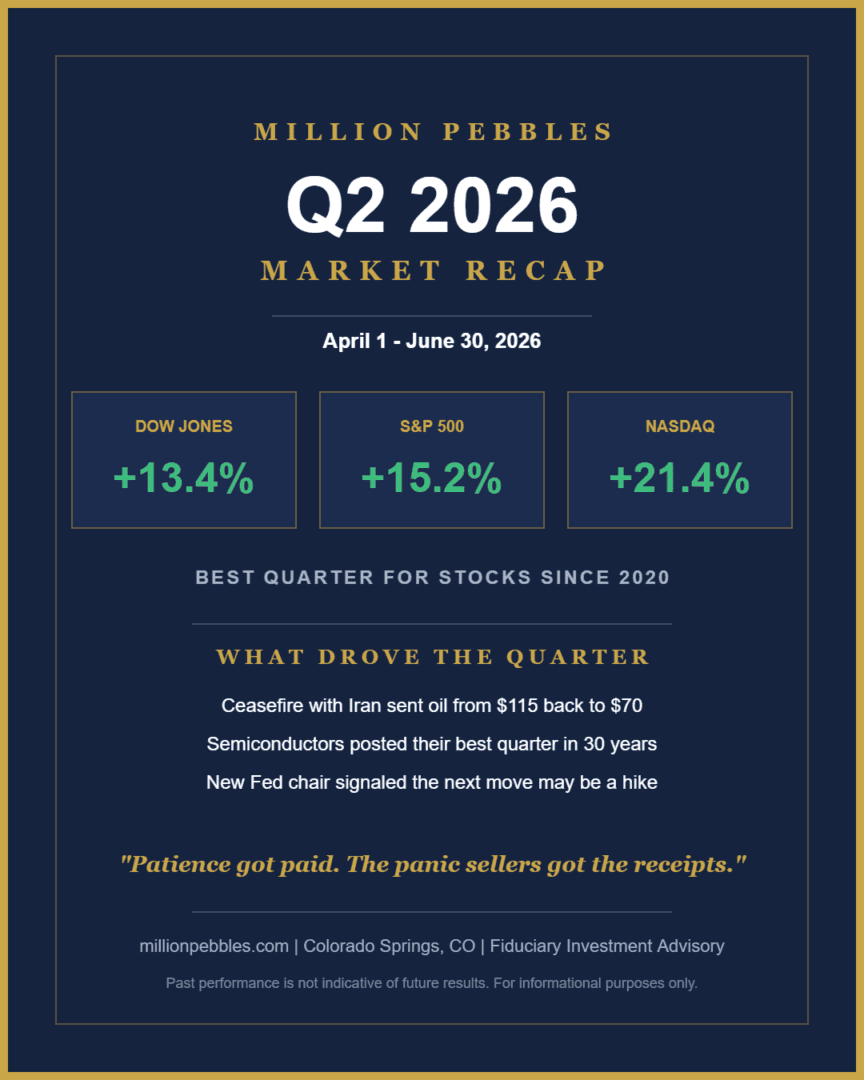
The S&P 500 gained 15.2%, its best quarter since the spring of 2020. The Nasdaq climbed more than 21%, and the Dow rose about 13% and closed at a record high. Smaller companies did even better, gaining more than 21%, and overseas markets rose about 24%. After two years of a few giant tech names doing all the work, the average stock finally got invited to the party. Honestly, it was overdue.
The war wound down, and oil went home
The conflict with Iran that rattled the first quarter didn’t end neatly, but it cooled off. A string of ceasefires led to an agreement signed in mid-June, and the Strait of Hormuz started reopening. Oil, which peaked near $115 a barrel in early April, fell all the way back to roughly $70 by the end of June. That’s basically where it sat before any of this started.
Remember the forecasts calling for $150 oil and gas lines around the block? They aged about as well as most panic does. The energy shock that defined the spring gave the money back by summer.
Earnings did the heavy lifting
While the headlines were busy with geopolitics, companies were quietly turning in one of the strongest earnings seasons in years. Profits for the big index grew about 29%, and the companies actually building all this AI everyone talks about led the way. Semiconductor stocks had their best quarter in almost 30 years.
A new voice at the Fed, and a plot twist on rates
The quarter also brought a changing of the guard. Kevin Warsh took over as Federal Reserve chairman, and his first meeting in June came with a message Wall Street didn’t love: rates are staying put, and the next move might be up, not down. May’s inflation reading hit 4.2%, a three-year high, mostly thanks to that spring oil spike.
Here’s the part worth knowing before you lose any sleep: take energy out of the number and inflation ran closer to 2.9%. With oil back at $70, a lot of that pressure should fade on its own. But the days of penciling in rate cuts like they’re a sure thing are over for now. Your plan was never supposed to depend on the Fed cooperating anyway.
The real lesson of the quarter
In early April, with oil near $100 and the market coming off its worst stretch in four years, the most natural instinct in the world was to sell, sit in cash, and wait for things to calm down. I get it. I heard it in plenty of conversations.
The people who followed that instinct missed a 15% quarter. Calm never sends a calendar invite. We’ve written before about why panic-selling tends to backfire, and this quarter handed out the receipts.
“Far more money has been lost by investors preparing for corrections than has been lost in corrections themselves.” — Peter Lynch
I’ve been doing this for nineteen years, and every scary quarter follows the same script: the headlines are loudest right before they stop mattering. The first quarter was the price of admission. The second quarter was the show.
What does this mean for you?
Stay invested, stick to the plan, and keep a healthy skepticism about both the panic and the celebration. The peace with Iran is a handshake, not a treaty. The Fed’s next move is a genuine coin flip. And after a 15% quarter, expectations are running hot. None of that is a reason to abandon a well-built plan. It’s the reason you have one. Saying yes to a plan, on purpose, is most of the battle.
If this quarter left you wondering whether your portfolio is built for whatever the second half brings, schedule a complimentary consultation. Worst case, you get a good cup of coffee and a second opinion that isn’t trying to sell you anything.
People also ask
How did the stock market do in Q2 2026?
The S&P 500 gained 15.2%, the Dow rose about 13% to a record high, and the Nasdaq climbed more than 21%, the strongest quarter for stocks since 2020.
Why did stocks rebound so sharply in Q2 2026?
Three things: a ceasefire with Iran that sent oil back to pre-conflict levels, exceptional corporate earnings led by semiconductors, and gains that finally spread beyond big tech to smaller companies and overseas markets.
Will the Fed raise rates in 2026?
Possibly. New Fed Chair Kevin Warsh signaled the next move could be a hike rather than a cut. Markets currently expect one or two, though falling oil prices may ease the pressure behind that shift.
This content is for informational and educational purposes only and does not constitute investment advice or a recommendation to buy or sell any security. Index performance figures referenced are based on publicly available data as of June 30, 2026. Past performance is not indicative of future results. Investing involves risk, including the possible loss of principal. Million Pebbles is a Registered Investment Advisor registered with the State of Colorado. Registration does not imply a certain level of skill or training.

Jeremy founded Million Pebbles in 2012 because financial advice had gotten more complicated — and expensive — than it needed to be. MBA. Registered Investment Advisor in Colorado. Will happily talk about estate and legacy planning, stocks, card collecting, or what families from Highlands Ranch to Flying Horse actually worry about when they call us at 9 a.m. on a Tuesday.
Educational only — not investment, tax, legal, or financial advice. Past performance doesn’t predict future results. Talk to a qualified professional before making any financial decisions.
Pebble Notes
Liked this? There’s more where that came from.
It’s what you just read, a few times a month, straight to your inbox. No jargon, no spam, and gone in one click the second it stops being worth your time.
Unsubscribe anytime. We’ll assume you got rich and moved on.