

A Dividend Is Not a Savings Account. Your Bank Is Paying You 0.38%. That Is Not a Typo.
Somewhere right now there’s a savings account with $50,000 in it earning 0.38%. That works out to about $190 a year. Call it fifty cents a day for lending a bank fifty grand. Meanwhile, that same bank will happily lend your money back to you at 7% on a home equity line.
That gap isn’t a glitch. It’s a business model. And this year, leaving cash lazy costs more than it has in a long time.
The rate story nobody saw coming
Coming into 2026, the whole market assumed rates were heading down. Then oil spiked, inflation hit a three-year high, and the Fed’s new chairman used his first meeting to signal that the next move might be a hike, not a cut. The Fed has now held steady at 3.50% to 3.75% all year.
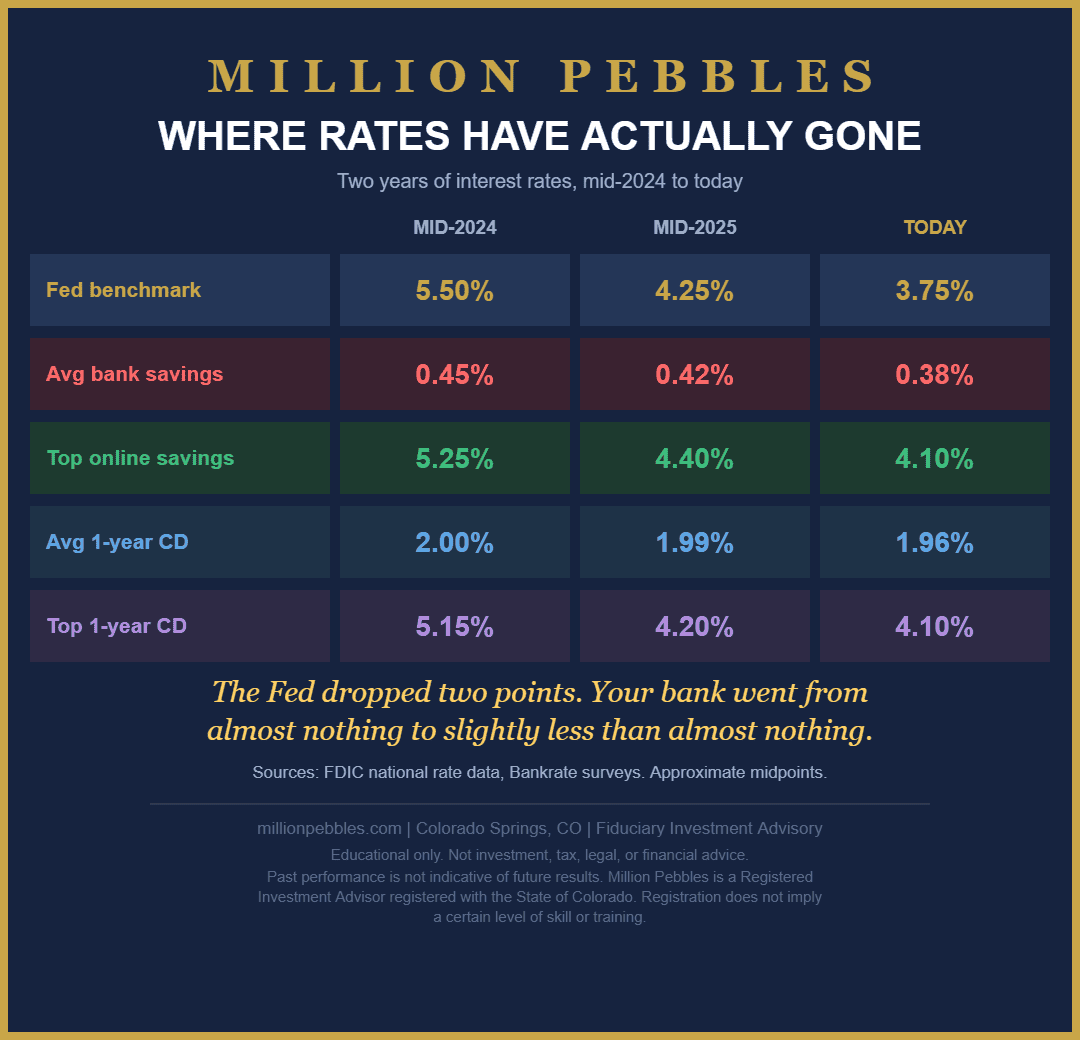
Here’s what that means for savers: the good yields everyone said were disappearing didn’t disappear. Look at the last two years.
Read that red row again. The Fed’s rate fell almost two full points. And the average bank savings account went from 0.45% to 0.38%, because it never bothered climbing in the first place. Big banks didn’t pay you when rates were high, and they won’t start now. The gap between the average account and the best account is the most reliable thing in this whole chart.
The lazy money ladder
Your cash has options.
High-yield savings accounts and CDs are the familiar rungs. They’re products at the bank, they’re insured, and they’ll always be the right home for money whose only job is to be there when you need it. Moving your emergency fund to a bank that actually pays interest is still the easiest win in personal finance.
And then there are other options with better potential rates of return, including equities. With bank interest finally beatable, people have noticed that some of America’s most familiar companies pay dividends above any savings account. Verizon yields north of 6% right now and has raised its dividend every year for about two decades. AT&T pays around 5.3%. Both trade cheap by their own history. Dividend stocks have become the conversation of the summer for a reason: the income is real, it arrives quarterly, and it doesn’t care what your bank branch is paying.
Tempting. Here’s the part that matters.
A dividend is not a savings account
This is where the fiduciary in me has to speak up. A 6% dividend and a 4% savings account are not the same thing at different prices. The savings account can’t lose principal. The stock can. Verizon and AT&T just had one of their worst weeks in years when investors got spooked about satellite competition. A 6% yield doesn’t help much if the share price drops 10% the week after you buy.
None of that makes dividend payers bad. For the right investor, in the right dose, in the right spot in a plan, steady dividend income is one of the oldest and best tools in the box. It just means the question was never “which pays more?” The question is “what job am I hiring this money to do?” An emergency fund has one job: be there. Long-term money has a different job entirely. Trouble starts when cash gets asked to do a stock’s job, or a stock gets asked to do cash’s job.
To be clear, this isn’t a recommendation to buy anything. It’s a nudge to notice what your money is doing right now, which for most people is nothing.
The one-hour audit
This week, look at every dollar of cash you hold and ask two questions. What is it earning? And what is its job? If the first answer is 0.38% and the second answer is a shrug, that isn’t a savings strategy. It’s a donation to your bank. We’ve written before about the quiet cost of waiting. Lazy cash is its favorite disguise.
If you’re not sure where the line sits between your safe money and your growth money, or whether your portfolio even has a line, schedule a complimentary consultation. We’ll figure out what jobs your dollars should have. No pressure, no products, no free steak dinner.
People also ask
What are high-yield savings accounts paying in 2026?
Top online banks pay around 4.10% APY, while the national average savings rate is 0.38%, per the FDIC.
Should I lock in CD rates now?
With the Fed signaling its next move could be a hike rather than a cut, today’s top CD rates near 4% may stick around. If inflation cools and cuts return, rates tend to fall fast. Laddering CDs spreads that timing risk.
Are dividend stocks a good alternative to savings accounts?
They do different jobs. Dividend stocks like Verizon pay more than savings accounts but carry principal risk, since share prices can fall. Savings accounts protect principal but pay less. Many plans hold both, in the right doses.
This content is for informational and educational purposes only and does not constitute investment advice or a recommendation to buy or sell any security. Index performance figures referenced are based on publicly available data as of July 2026. Past performance is not indicative of future results. Investing involves risk, including the possible loss of principal. Million Pebbles is a Registered Investment Advisor registered with the State of Colorado. Registration does not imply a certain level of skill or training.

Jeremy founded Million Pebbles in 2012 because financial advice had gotten more complicated — and expensive — than it needed to be. MBA. Registered Investment Advisor in Colorado. Will happily talk about estate and legacy planning, stocks, card collecting, or what families from Highlands Ranch to Flying Horse actually worry about when they call us at 9 a.m. on a Tuesday.
Educational only — not investment, tax, legal, or financial advice. Past performance doesn’t predict future results. Talk to a qualified professional before making any financial decisions.
Pebble Notes
Liked this? There’s more where that came from.
It’s what you just read, a few times a month, straight to your inbox. No jargon, no spam, and gone in one click the second it stops being worth your time.
Unsubscribe anytime. We’ll assume you got rich and moved on.