

30A Town Rosemary Is Barely Thirty Years Old
New here? Pebble Notes is money talk that won’t put you to sleep.
Free, a few times a month.
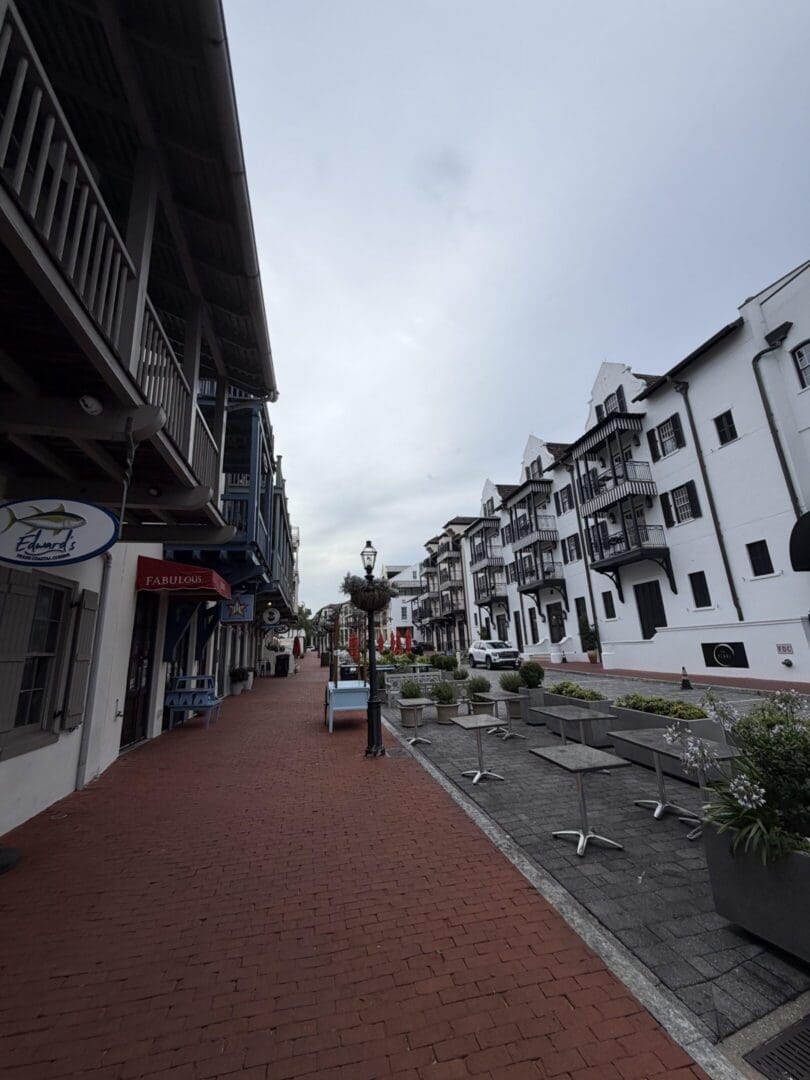
Walk into Rosemary Beach for the first time and your brain does a double take. The white town hall, the crushed-shell paths, every house painted in the same handful of muted colors, the boardwalks ducking off into the dunes. It feels old. Settled. Like families have been walking down to the water from these porches for a hundred years.
Then somebody tells you the place is younger than your car. Rosemary Beach was founded in 1995. It is barely thirty. That gap, between how old it feels and how old it actually is, is the whole story. And it is not an accident. Somebody designed that feeling on purpose, down to the last shutter.
Before it was anything
The strip of Walton County that Rosemary sits on used to be the unglamorous edge of an older neighborhood called Inlet Beach. Before that it was Creek and Euchee land, dunes and scrub and not much else, the kind of Gulf coast nobody had figured out how to sell yet.
The name comes from Rosemary Milligan, a realtor who had been kicking around the area since the 1970s and owned a big chunk of the land before the developers showed up. So the town is not named after the herb in the dunes, like everyone assumes. It is named after the woman who held the dirt.
The part where they hire the right people
In 1995 a developer named Patrick Bienvenue, running point for Leucadia, put together the Rosemary Beach Land Company and made one decision that mattered more than all the others. He hired Andres Duany and Elizabeth Plater-Zyberk.
If those names do not ring a bell, the work will. They are the husband-and-wife firm, DPZ, that built Seaside a few miles down the road, the town so charming they filmed The Truman Show in it. They later did Alys Beach too. So the three prettiest, priciest little towns on 30A all came off the same drafting table. That is not a coincidence. That is a house style.
What they practice is called New Urbanism, which is a fancy term for a simple idea: build a town the way people built them before the car started bossing everyone around. Put everything within a five-minute walk. Shove the parking into alleys out back so the streets stay quiet. Point the front doors at boardwalks and little green parks instead of at traffic. Add carriage houses so families have a guest room or a rental over the garage. Make people bump into each other on foot.
It sounds obvious. In 1995 it was almost radical. The whole country had spent fifty years sprawling out into cul-de-sacs and three-car garages, and here were these two arguing that the old way, the walkable, neighborly, slightly cramped way, was actually better. Rosemary Beach was them proving it.
Why it looks the way it looks
The look did not come from nowhere either. The design team went shopping in the past. You can see New Orleans in the ironwork, Charleston and St. Augustine in the porches, the West Indies and the Caribbean in the deep overhangs and high ceilings built to move hot air around before anyone had air conditioning to lean on.
And there is a rule underneath all of it that I love. If something is supposed to look like wood, it is wood. Real materials, natural colors, nothing faking anything. The town hall, finished in 1999 with its white stucco and that Dutch West Indies roofline, sets the tone, and everything else falls in behind it. There is a code, an actual rulebook a town architect enforces, and that code is why the place still looks like itself thirty years on instead of slowly turning into a strip mall.
The Vault part
Here is what gets me about Rosemary Beach, and why it belongs in here.
The charm feels effortless, and it is the opposite of effortless. Every secret footpath, every neutral shutter, every house turned to face a green instead of a road, all of it is somebody making a hard, disciplined choice and then refusing to break it for three decades. You are not looking at an old town. You are looking at thirty years of people saying no to the easy, ugly, profitable shortcut.
Then add the part where they are not making any more of it. A hundred and seven acres, a little over four hundred homes, a fixed slice of Gulf-front, and a code that will not let anyone cram in more. Tight supply and a town that refuses to cut corners. That shows up in the price tags, which are ridiculous. Go pull up a listing sometime and brace yourself.
That is the lesson hiding in a pretty beach town. The things that last, the ones that hold their value and make you stop and stare, almost never happen by accident. Somebody decided, on purpose, what they were going to be, and then had the patience to let it get there slowly. A town pulled that off. The same thing works for a portfolio. Almost nobody has the patience for it.
Rosemary is barely thirty and it already feels two hundred. That was the entire point. Which is the impressive and slightly annoying thing about the place. None of it just happened. Somebody sat in a room in 1995 and decided it, and then a lot of people spent thirty years not screwing it up.

Pebble Notes is where Million Pebbles thinks out loud. A fee-only fiduciary RIA in Colorado serving families from Briargate to Cherry Creek. We read too much Bloomberg, IPO filings, Nasdaq, and occasionally fall down rabbit holes about twin turbo Porsches, Pokémon cards, and Dr. Seuss art. Pebble Notes is what survives the edit.
Pebble Notes
Liked this? There’s more where that came from.
It’s what you just read, a few times a month, straight to your inbox. No jargon, no spam, and gone in one click the second it stops being worth your time.
Subscribe freeUnsubscribe anytime. We’ll assume you got rich and moved on.