New here? Pebble Notes is money talk that won’t put you to sleep.
Free, a few times a month.
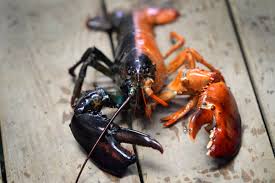
Somewhere off the coast of Maine, a fisherman pulled up a lobster that looked like it had a serious identity crisis. One side was the usual moody, dark green-brown. The other side? A bright, cooked-looking orange — as if half of it had already met a pot of butter and forgotten to tell the rest of the body.
The catch is called a
split-colored lobster. The odds of pulling one up: roughly
1 in 50 million. To put that in perspective, you’re more likely to be struck by lightning twice in your life than to ever see one in person. They’re rarer than blue lobsters (1 in 2 million), rarer than yellow (1 in 30 million), and only out-rared by ghostly white “crystal” lobsters (1 in 100 million).
Scientists love it. Marine biologists pose with it. Lobster fishermen, who have spent careers staring into traps, often call it the most unusual thing they’ve ever pulled from the sea.
This particular lobster got lucky twice. The first time when nature handed her a one-in-fifty-million shell. The second time when the fisherman skipped the boiling pot and called Woods Hole instead. She’s now in the care of marine biologists at the
Woods Hole Aquarium in Massachusetts — the oldest public aquarium in the country — where she’ll be one of the first animals featured when the renovated facility reopens to visitors in early 2027. From dinner plate to full-time celebrity, basically.
If this all sounds familiar, it should. We talked about it a few weeks ago in our
Connoisseur’s Collecting Series with Pokémon cards: a base set Charizard from 1999 that someone stuck in a binder is now worth more than a luxury sedan. A Holographic Pikachu Illustrator card recently sold for over five million dollars. The same principle applies to the things we love and the things we own — most of it is ordinary, and a tiny sliver of it is extraordinary in ways nobody saw coming.
The same instinct shows up in investing — most days look ordinary, and once in a while a moment arrives where the right move is the opposite of what feels right. That’s the psychology behind
why panic-selling tends to backfire: the rare days carry most of the returns.
Rare things stay rare for a reason.
And every once in a while, one of them ends up in your trap.
Investing well isn’t about catching the rare lobster — it’s about being there when the tide comes in. Schedule a complimentary conversation with Million Pebbles. Fiduciary, fee-only, serving Front Range Colorado. 🐝
This post is for educational and entertainment purposes only. It does not constitute investment, tax, or legal advice. See site footer for full disclosures.

Author · The Million Pebbles team
Million Pebbles, MBA-led · Registered Investment Advisor in Colorado
Pebble Notes is where Million Pebbles thinks out loud — a fee-only fiduciary RIA in Colorado serving families from Briargate to Cherry Creek. We read too much Bloomberg, IPO filings, Nasdaq, and occasionally fall down rabbit holes about twin turbo Porsches, Pokémon cards, and Dr. Seuss art. Pebble Notes is what survives the edit.
Coffee? 🐸 →
What We Tell Clients About Black Swans
When the rare event shows up — the 2008, the 2020, the 2023 regional banking shock — clients usually do one of two things: panic-sell, or freeze entirely. Both feel safe. Both are usually wrong.
The third option, the one we recommend, is the boring one: stick to the plan you wrote when nothing was on fire. That plan exists for moments exactly like this. If you didn’t write one, the moment you most need it is the moment it’s hardest to write.
Plan first. Lobster second.
Educational only — not investment, tax, legal, or financial advice. Past performance doesn’t predict future results. Talk to a qualified professional before making any financial decisions.
Pebble Notes
Liked this? There’s more where that came from.
It’s what you just read, a few times a month, straight to your inbox. No jargon, no spam, and gone in one click the second it stops being worth your time.
Subscribe freeUnsubscribe anytime. We’ll assume you got rich and moved on.