

Stocks Slipped, Oil Spiked, and Tech Got Humbled — Your Q1 2026 Market Recap
New here? Pebble Notes is money talk that won’t put you to sleep.
Free, a few times a month.
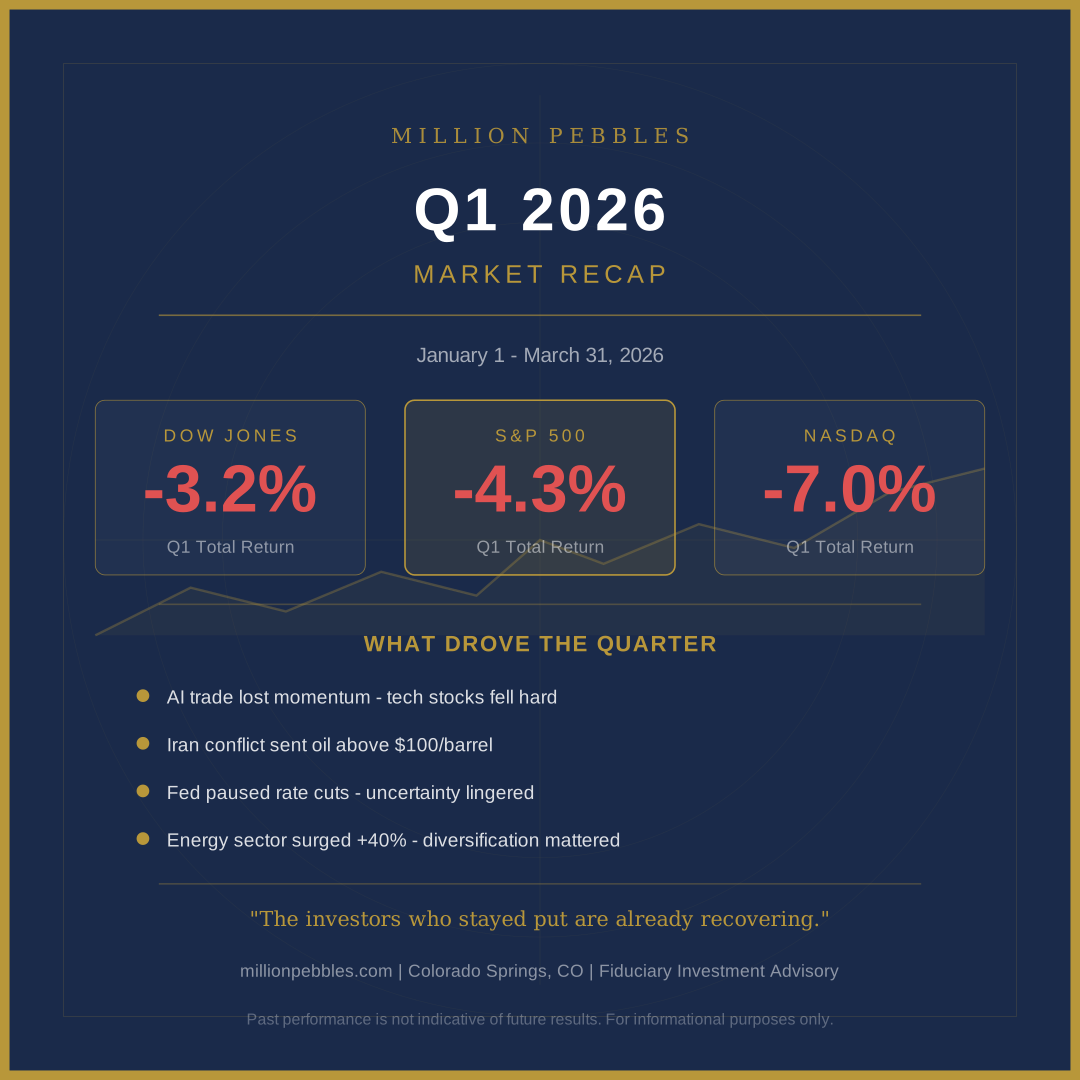
If the first quarter of 2026 taught investors anything, it’s that markets can shift fast — and that the reasons are almost never the ones you were expecting at the start of the year. Coming into January, the mood was cautiously optimistic. Corporate earnings were strong, the economy was growing, the Federal Reserve seemed done tightening, and the AI-driven tech rally that had powered markets through 2024 and 2025 showed no obvious signs of stopping. Then, over the course of three months, a geopolitical conflict, an AI reality check, and a dramatic sector rotation turned what looked like a smooth runway into a genuinely bumpy quarter. Here’s what actually happened — and what it means for long-term investors.“The investors who stayed put are already recovering.”
— Million Pebbles | Q1 2026 Market Recap
The numbers first
Let’s start with the scoreboard, because the headline numbers tell the story pretty clearly:- S&P 500: -4.3% for Q1 2026
- Dow Jones Industrial Average: -3.2% for Q1 2026
- Nasdaq Composite: -7.0% for Q1 2026
So what actually drove the selloff?
Three things converged — and they were connected in ways that made the quarter more volatile than any single factor would suggest on its own. The AI trade ran out of momentum. For two years, a small group of mega-cap technology companies — the so-called Magnificent 7 — had been driving the majority of market gains. In Q1, that changed. Investors started asking harder questions about the timeline for returns on the enormous AI spending that had been lifting these stocks. Microsoft, for example, fell over 23% during the quarter. When the largest stocks in the index start falling, the index tends to follow — and that’s exactly what happened. The Information Technology sector dropped roughly 9% for the quarter. Geopolitical tension changed everything in March. In late February, the U.S. launched a military offensive on Iran. The ripple effects were immediate and severe. The Strait of Hormuz — through which roughly 20-30% of global crude oil flows — was effectively disrupted. Oil prices, which had started the year around $57 a barrel, surged above $100. Gas prices at the pump hit $4 a gallon by late March. The Energy sector, which makes up only about 4% of the S&P 500, surged nearly 40% for the quarter — its best single-quarter performance since early 2022. Everything else, outside of defensive sectors, got hit. The Fed stayed on the sidelines. The Federal Reserve paused its rate-cutting cycle in January, citing a stable economy and resilient consumer spending. That was the right call at the time, but as geopolitical pressures pushed energy prices higher and inflation concerns resurfaced, markets began pricing in the possibility of a more challenging path forward for rate cuts in 2026. That uncertainty weighed on growth stocks and high-multiple names throughout the quarter.The hidden story: a dramatic rotation
Here’s what the headline numbers don’t show: beneath the surface, Q1 2026 was actually a fascinating quarter for diversified investors. While tech dragged the major indexes lower, plenty of parts of the market performed very well. Energy was the obvious winner — up nearly 40%. But defensive sectors like Utilities, Consumer Staples, and Materials also posted positive returns. The Russell 2000, which tracks small-cap stocks, showed relative resilience compared to the tech-heavy Nasdaq. International markets, particularly in Europe and emerging markets, held up better than U.S. large caps for much of the quarter. This is exactly why diversification matters — not just across stocks, but across sectors, geographies, and asset classes. A portfolio concentrated heavily in the mega-cap tech names that drove 2024 and 2025 got hit hard in Q1. A broadly diversified portfolio looked quite different.Bonds provided some stability
The Bloomberg U.S. Aggregate Bond Index was essentially flat for the quarter — not exciting, but exactly the stabilizing role bonds are supposed to play when equities are under pressure. For investors with appropriate fixed income allocations, the bond side of the portfolio acted as a buffer during a difficult stretch for stocks.What does this mean for you?
A quarter like Q1 2026 tests investor discipline in a specific way. When markets are falling, volatility is rising, and the headlines are dominated by conflict and uncertainty, it’s tempting to do something — to reduce risk, move to cash, or make dramatic changes to your portfolio. Most of the time, that instinct costs investors money. The quarter ended with a sharp rally that many investors who had moved to the sidelines missed entirely. And looking back over the past 12 months, markets have still performed strongly overall — the sharp Q1 decline needs to be understood in the context of the significant gains that preceded it. None of this means the road ahead is smooth. Geopolitical tensions remain elevated. The Fed’s path is uncertain. AI valuations are being recalibrated. Midterm elections later this year will add another layer of noise. These are real factors and they deserve serious consideration in how portfolios are structured. But the core principles don’t change: stay diversified, keep your allocation aligned with your actual time horizon, and don’t let a rough quarter drive decisions that were designed for much longer timeframes.Looking ahead to Q2
Early April has brought some relief, with markets rebounding on ceasefire hopes in the Middle East and early Q1 earnings results coming in better than feared. But it’s still early, and there’s a lot of quarter left. The key themes to watch: oil prices and Middle East developments, the Fed’s next moves, AI spending commentary in corporate earnings, and any updates on trade policy. We’ll be watching all of it — and as always, if you want to talk through what Q1 means for your specific situation, we’re here for that conversation. Schedule a complimentary consultation with our Colorado Springs team. No pressure — just a straightforward conversation about your portfolio and what’s ahead.People also ask
Why did the stock market drop in Q1 2026? Three main factors drove the Q1 decline: a slowdown in the AI-driven tech rally that had powered markets in 2024-2025, the escalation of the U.S.-Iran conflict which disrupted oil supplies and pushed energy prices sharply higher, and the Federal Reserve’s decision to pause interest rate cuts amid renewed inflation concerns. Which index performed best in Q1 2026? Among the major U.S. indexes, the Dow Jones held up best at -3.2%, followed by the S&P 500 at -4.3%, and the Nasdaq at -7.0%. Outside of U.S. large caps, the Energy sector surged nearly 40%, and international markets showed relative resilience compared to tech-heavy U.S. indexes. Should I be worried about my portfolio after Q1 2026? A -4% quarter is uncomfortable but not unusual. The S&P 500 has experienced corrections of this magnitude or larger in most years, and markets have historically recovered. The more important question is whether your portfolio is appropriately diversified and aligned with your time horizon — not whether a single quarter’s returns require action. If Q1 had you tempted to do something dramatic with your portfolio, two related reads are worth a few minutes: why panic-selling tends to backfire, and why the most interesting long-term ideas often look boring up close.This content is for informational and educational purposes only and does not constitute investment advice or a recommendation to buy or sell any security. Index performance figures referenced are based on publicly available data as of March 31, 2026. Past performance is not indicative of future results. Investing involves risk, including the possible loss of principal. Million Pebbles is a Registered Investment Advisor registered with the State of Colorado. Registration does not imply a certain level of skill or training.

Pebble Notes is where Million Pebbles thinks out loud — a fee-only fiduciary RIA in Colorado serving families from Briargate to Cherry Creek. We read too much Bloomberg, IPO filings, Nasdaq, and occasionally fall down rabbit holes about twin turbo Porsches, Pokémon cards, and Dr. Seuss art. Pebble Notes is what survives the edit.
Educational only — not investment, tax, legal, or financial advice. Past performance doesn’t predict future results. Talk to a qualified professional before making any financial decisions.
Pebble Notes
Liked this? There’s more where that came from.
It’s what you just read, a few times a month, straight to your inbox. No jargon, no spam, and gone in one click the second it stops being worth your time.
Subscribe freeUnsubscribe anytime. We’ll assume you got rich and moved on.